

Key Takeaways
- A portfolio website and LinkedIn are not competing tools; they solve different problems in a job search or freelance pitch.
- LinkedIn wins on discovery, networking, and algorithm-driven visibility to recruiters.
- A portfolio website wins on depth, design control, and the ability to tell a full story without platform limits.
- Students, career changers, and freelancers usually benefit the most from running both at the same time.
- The two work best when they are linked to each other and updated on the same schedule, not treated as separate projects.
Portfolio website vs. LinkedIn is one of the most common questions job seekers, freelancers, and career changers ask once they start taking their job search or client pitching seriously. The short answer: most people need both, but for very different reasons, and mixing up those reasons is where a lot of personal branding effort gets wasted.
How to Decide Between a Portfolio Website and LinkedIn
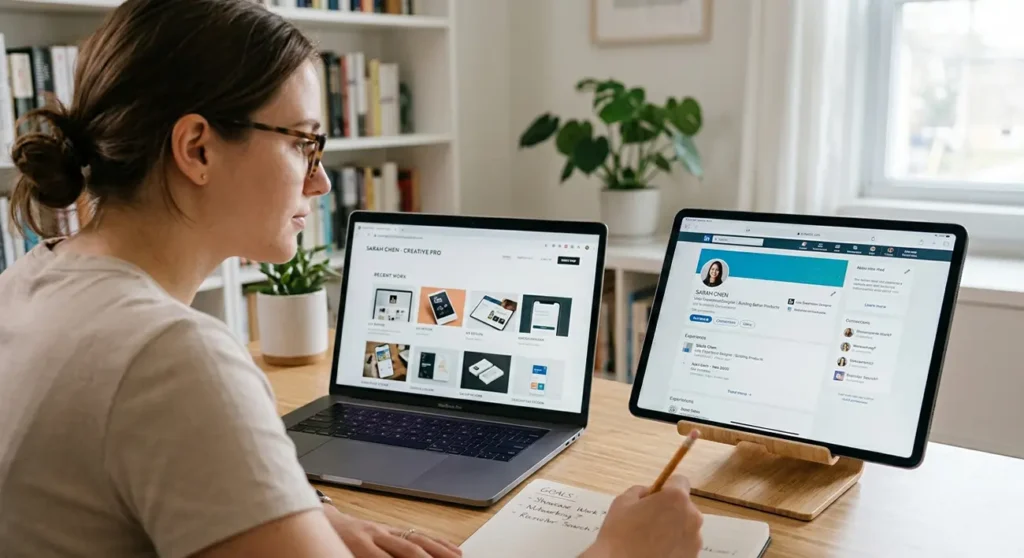
Before building either one, it helps to get clear on the actual goal. A recruiter search, a freelance pitch, and a networking event all call for different proof points, and trying to use one tool for every situation usually backfires.
- Step 1: Identify the primary goal, whether that is getting found by recruiters, pitching freelance clients, or building a professional network.
- Step 2: Match LinkedIn to goals that involve being discovered by strangers, since its search and algorithm exist for exactly that.
- Step 3: Match a portfolio website to goals that involve proving skill in depth, such as showing finished projects, case studies, or writing samples.
- Step 4: Build both if the goal touches on more than one of these areas, which is the case for most active job seekers and freelancers.
What LinkedIn Handles Better Than a Portfolio Website
LinkedIn is still the first place many recruiters and hiring managers check, and for good reason. Its strength is not depth; it is reach.
- Recruiters actively search LinkedIn using keywords, job titles, and skills, which means a well-optimized profile can get found without any outreach at all.
- Endorsements, recommendations, and mutual connections act as quick social proof that a stranger can verify in seconds.
- Posts and comments build visibility over time, keeping a name in front of the right industry circles.
- It requires no maintenance beyond keeping the profile current, unlike a website that needs hosting and occasional updates.
What a Portfolio Website Handles Better Than LinkedIn
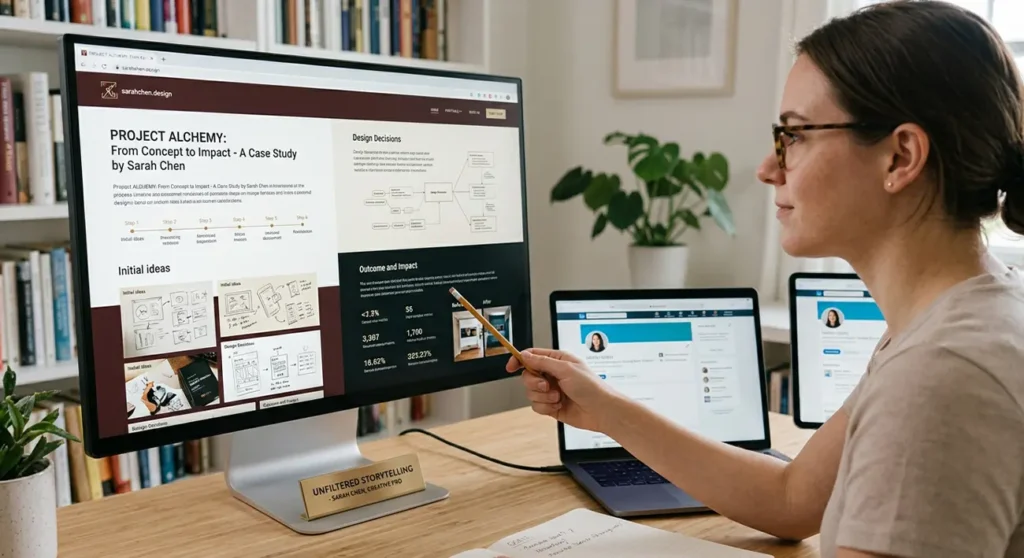
A portfolio website exists to do the one thing LinkedIn was never built for: telling a complete, unfiltered story about the work itself.
- There is full control over layout, tone, and what gets featured first, rather than fitting into a fixed template.
- Case studies can include process, decisions, and outcomes in detail, not just a bullet point and a job title.
- There is no algorithm limiting who sees a project or how it gets ranked in front of other people’s updates.
- A custom domain signals a level of seriousness that a shared profile URL cannot match, especially for freelancers and consultants.
Pro-Tip: Most hiring managers and clients decide whether someone is worth a closer look within the first thirty seconds of landing on a portfolio. Put the strongest project first, not the most recent one, since recency and relevance are rarely the same thing.
When You Actually Need Both
The Student Applying for Internships
A student with limited work history often has more to gain from a portfolio than a seasoned professional does. Class projects, personal builds, and volunteer work can be shown in full on a website, while LinkedIn alone tends to look thin at this stage. Most students applying for internships find that a short portfolio with two or three solid projects outperforms a polished LinkedIn profile with no proof behind it.
The Career Changer Switching Industries
Career changers face a specific problem: their LinkedIn history points backward, toward the old industry, right when they need to point forward. A portfolio website lets a career changer lead with transferable skills, relevant side projects, or a career-change statement that LinkedIn’s rigid format makes awkward to include.
The Freelancer Chasing High-Value Clients
A freelancer relying only on a LinkedIn profile is often competing on the same page as dozens of similar profiles in a client’s search results. A portfolio website changes that dynamic entirely, since it becomes the one place a prospective client goes to make a final decision, away from competitors and distractions. This works best when the portfolio is built with the client’s decision-making process in mind, not just as a list of past jobs.
How to Make a Portfolio Website and LinkedIn Work Together
Running both is only useful if they reinforce each other instead of repeating the same information twice.
Method 1: Mirror Headlines, Not Content
The headline and positioning statement should match across both platforms, but the actual content should not be copy-pasted. LinkedIn’s about section can summarize; the portfolio can go deep.
Method 2: Link Directly, Not Through a Maze
The LinkedIn featured section and contact info should link straight to the portfolio, and the portfolio should link back to LinkedIn for networking. A platform such as Portfoliomo makes this easier by keeping the portfolio structure simple enough to update the moment a new project ships.
Method 3: Use LinkedIn to Drive Traffic to the Portfolio
Posts about a recent project, written in a few sentences, can end with a link to the full case study on the portfolio. This turns LinkedIn into a discovery channel instead of the final destination. For anyone starting from scratch, the get-started page walks through building that first version quickly, and the pricing page lays out what is included at each plan level.
Pro-Tip: Most people forget to update both places at the same time after a career change or a new project launch. Set a recurring reminder, even a simple monthly one, to check that the portfolio and LinkedIn still tell the same story.
Common Mistakes When Choosing Between a Portfolio Website and LinkedIn
- Treating LinkedIn as a complete replacement for a portfolio, then wondering why interview requests dry up once a recruiter wants to see actual work.
- Building a portfolio website once and never updating it, so it eventually shows older, weaker work instead of the most recent and relevant projects.
- Copying the entire LinkedIn profile onto the portfolio’s homepage, which wastes the one advantage a website has: depth.
- Leaving no clear link between the two, forcing a recruiter or client to search for the other platform instead of clicking straight to it.
- Choosing a generic, hard-to-navigate site structure that buries the best project instead of leading with it.
Tips for the Future: Keeping Both Updated as Career Goals Change
Personal branding is not a one-time project, and the balance between LinkedIn and a portfolio website often shifts as career goals change.
- Revisit the portfolio every time a new project, client, or role wraps up, and add it before moving on to the next thing.
- Adjust the LinkedIn headline and portfolio positioning together whenever the target role or client type changes.
- Remove outdated projects from the portfolio the same way old jobs eventually drop off a resume, keeping only what still represents current skill level.
- Check both platforms from a stranger’s point of view once or twice a year, since it becomes harder to spot gaps in something built and re-read too many times.
In 2026 and beyond, hiring managers and clients are unlikely to stop checking either platform, which means the smartest long-term move is keeping both current rather than picking one and neglecting the other.
Frequently Asked Questions
Is a portfolio website necessary if LinkedIn is already complete?
A complete LinkedIn profile still cannot show detailed case studies, custom design, or a curated project order the way a portfolio website can, so most active job seekers and freelancers benefit from having both.
Which one should come first, LinkedIn or a portfolio website?
LinkedIn usually comes first since it takes less time to set up and starts building visibility immediately, while the portfolio can be built in parallel or shortly after.
Do freelancers need a portfolio website even with an active LinkedIn presence?
Yes, since clients comparing multiple freelancers tend to make final decisions based on a dedicated site, not a shared profile page sitting next to competitors.
How often should a portfolio website be updated?
Updating after every major project or role change works well for most people, rather than waiting for a scheduled overhaul once a year.
Can a portfolio website replace a resume entirely?
In most hiring processes, no; a resume is still commonly requested for applicant tracking systems, but a portfolio website adds proof that a resume alone cannot provide.
What should go on a portfolio homepage first?
The strongest, most relevant project should lead, followed by a short positioning statement, since most visitors decide within seconds whether to keep browsing.
Is it worth building a portfolio website for a first job search with little experience?
Yes, since class projects, personal work, or volunteer contributions can fill the gap that a thin LinkedIn history leaves behind.
How should LinkedIn and a portfolio website link to each other?
The portfolio link should sit in the LinkedIn featured section and contact info, while the portfolio should include a direct link back to the LinkedIn profile for networking purposes.
Does industry type affect whether a portfolio website is needed?
Yes, visually driven or project-based fields such as design, writing, marketing, and development tend to need a portfolio more urgently than fields where LinkedIn alone is the norm.