
Key Takeaways
- A personal website gives job seekers a controlled space to prove skills, something a resume or LinkedIn profile cannot fully do.
- Recruiters and hiring managers scan applications quickly, so visual proof of work matters more than another bullet-point list.
- Students, career changers, and freelancers each need a personal website, but the content and structure should differ for each.
- Most job seekers can launch a working personal website in a weekend using ready-made portfolio templates, no coding needed.
- Avoiding a handful of common personal website mistakes makes the difference between a site that gets ignored and one that gets a reply.
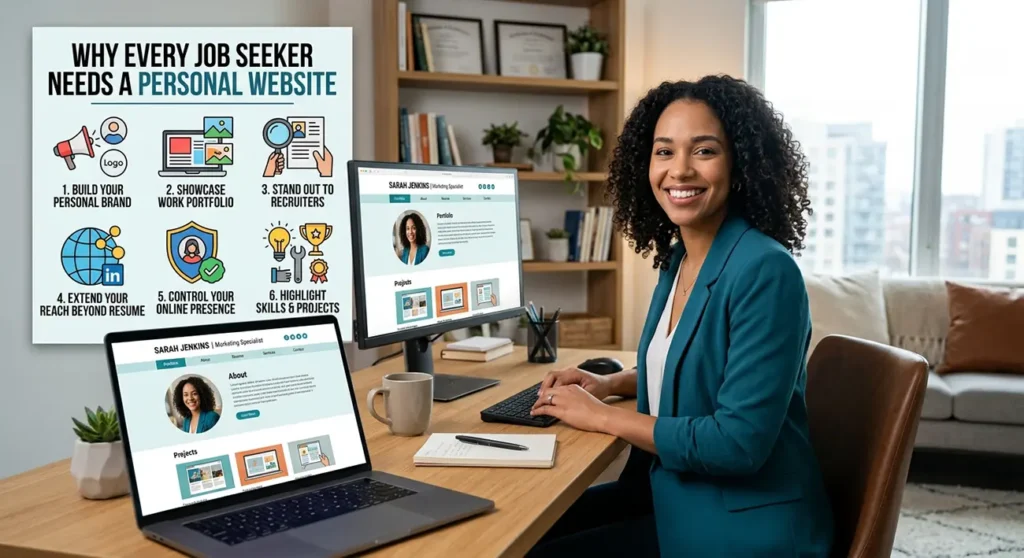
Every job seeker needs a personal website in 2026 because hiring has shifted, and a resume alone no longer tells recruiters enough. Applicant tracking systems filter out qualified candidates before a human even opens the file, and LinkedIn profiles look nearly identical to thousands of others in the same field. A personal website solves both problems by giving a job seeker a space that recruiters, hiring managers, and freelance clients can visit directly, without competing for attention in a crowded inbox or feed.
Building a Personal Website That Actually Gets Job Seekers Hired
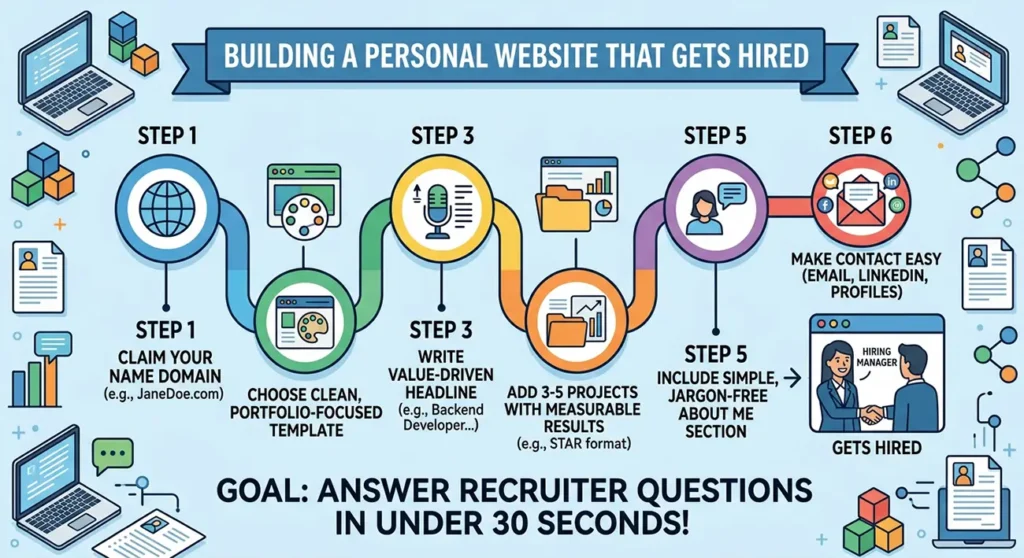
The goal is not a flashy design. The goal is a site that answers a recruiter’s questions in under thirty seconds. Most job seekers find that following a simple structure works better than trying to reinvent the format.
- Step 1: Claim a domain that uses the job seeker’s actual name, not a nickname or a company-sounding phrase, since recruiters often search a candidate’s name directly.
- Step 2: Pick a clean, fast-loading template built for portfolios rather than a generic business layout; browsing a set of job-seeker focused templates saves hours of trial and error.
- Step 3: Write a homepage headline that states the role being targeted and the specific value offered, such as ‘Backend developer who cuts API response times in half,’ instead of a vague label like ‘Passionate professional.’
- Step 4: Add three to five project or work samples with a short explanation of the problem, the action taken, and the measurable result.
- Step 5: Include a short, specific about section that explains the career path in plain language, avoiding jargon that only makes sense inside one company.
- Step 6: Make contact effortless with a visible email address or contact form, plus links to LinkedIn and any relevant professional profiles.
Pro-Tip: Most job seekers bury the strongest project on an inner page. Recruiters rarely click past the homepage on a first visit, so the single best piece of proof should sit above the fold, not three clicks deep.
Why a Resume or LinkedIn Profile Alone Falls Short in 2026
Resumes are built to be scanned by software before a person ever reads them, which forces job seekers to write for keyword matching rather than for clarity. LinkedIn, meanwhile, limits formatting, buries older posts, and puts every profile inside the same template as millions of competitors. A personal website removes both constraints. It lets a job seeker control the layout, the order of information, and the story being told, which matters most for career changers whose resume history does not obviously connect to the role they now want.
Hiring managers also use a personal website as a filter for initiative. Building one, even a simple one, signals that a candidate takes the job search seriously enough to invest time beyond submitting the same application everyone else sends.
What Recruiters and Hiring Managers Notice First
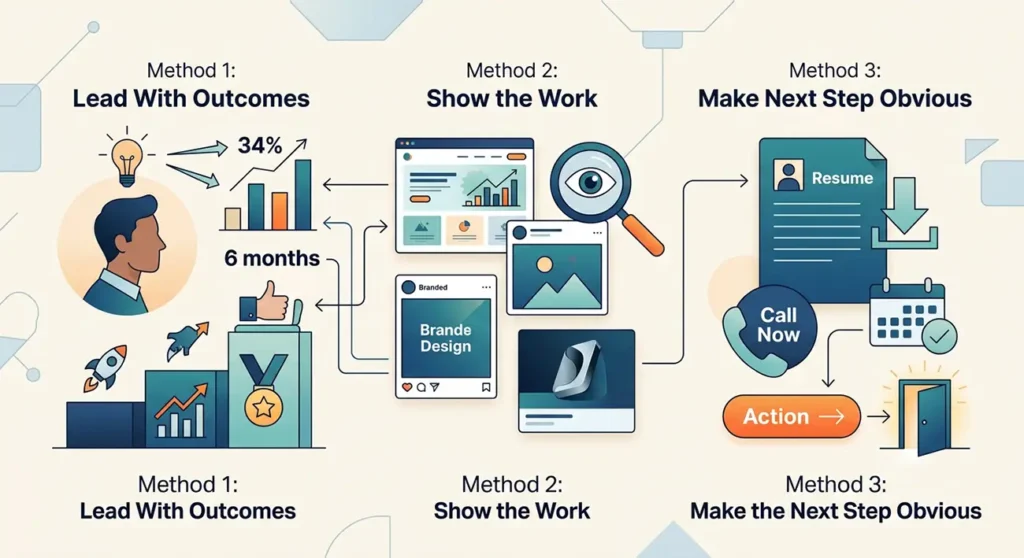
Recruiters do not read a personal website top to bottom on the first visit. They scan, and what they scan for is fairly predictable across industries.
Method 1: Lead With Outcomes, Not Job Titles
A title like ‘Marketing Coordinator’ tells a recruiter almost nothing. A line like ‘Grew email open rates from 12 percent to 34 percent in six months’ tells them everything they need to keep reading. The key is to translate every past role into a result, even in entry-level or internship experience.
Method 2: Show the Work, Do Not Just List It
A bullet point that says ‘Designed marketing materials’ is a claim. A page that shows the actual materials, with a sentence of context, is proof. This distinction matters most for freelancers chasing a new client, since a prospective client is comparing proof, not adjectives, when choosing between candidates.
Method 3: Make the Next Step Obvious
Every page should point toward one clear action, whether that is downloading a resume, sending an email, or booking a call. A site with no clear next step often gets closed without a single message sent, even when the work on it is strong.
Personal Website Scenarios Worth Planning Around
The right personal website looks different depending on who is building it. The structure above still applies, but the emphasis shifts.
The Student Applying for Internships
A student rarely has years of paid work to show, so coursework projects, class assignments, and volunteer work belong front and center. What matters is showing the thinking behind the work, not apologizing for a thin resume.
The Career Changer Switching Industries
A career changer benefits from an about section that connects old experience to the new field directly, rather than hoping a recruiter makes that leap alone. Transferable skills need to be named explicitly, not implied.
The Freelancer Chasing a New Client
A freelancer’s site should read like a sales page more than a resume. Case studies, client results, and clear service descriptions matter more here than a chronological work history, since a client is deciding whether to pay, not whether to hire full time.
Common Mistakes Job Seekers Make With Personal Websites
- Copying resume text directly onto the homepage instead of rewriting it for a skimmable, visual format.
- Using a template so overloaded with animation and imagery that it slows load time and buries the actual content.
- Leaving contact information hard to find, buried on a separate page instead of visible from every screen.
- Listing skills without any project or example that proves those skills were actually used.
- Letting the site sit untouched for a year or more, so it references an old role or an outdated portfolio piece.
Pro-Tip: A surprising number of personal websites lose visitors because the contact link opens a broken form or an inbox that is checked once a month. A site is only as useful as the speed of the reply it makes possible.
Tips for the Future: Keeping a Personal Website Working Long-Term
A personal website is not a one-time project. It needs light, regular attention to keep working as a job search or freelance tool.
- Update the project section every time a meaningful piece of work is finished, rather than waiting for a big annual refresh.
- Revisit the homepage headline whenever the target role changes, since a headline written for one job rarely fits the next.
- Check load speed and mobile display every few months, since templates and browsers both change over time.
- Read through the PortfolioMo blog periodically for updated advice on hiring trends and portfolio structure.
Job seekers who treat their site as a living document, rather than a finished task, tend to get more consistent results from it over time. A platform like PortfolioMo makes this ongoing maintenance simpler, since updates do not require touching any code.
Frequently Asked Questions
Does a personal website really matter more than a resume in 2026?
A resume is still required for most applications, but a personal website adds context and proof that a resume format cannot include, which is why the two work best together rather than as a replacement for one another.
How long should it take to build a personal website?
A basic, effective site can be built in a weekend using a portfolio template, since the main work is organizing existing project examples rather than designing a layout from scratch.
Does a personal website need to be free to build?
A free option can work for a simple starting point, but most job seekers eventually move to a paid plan for a custom domain and better templates; comparing portfolio website pricing options helps decide when that upgrade makes sense.
What should a student include without much work experience?
Coursework projects, class presentations, volunteer work, and any freelance or part-time work all count as legitimate proof of skill, as long as the results and thinking behind them are explained clearly.
Should a personal website replace a LinkedIn profile?
No. A personal website and a LinkedIn profile serve different purposes, and the two should link to each other so recruiters can move easily between a professional network and a fuller portfolio.
How many projects should be shown on a personal website?
Three to five strong examples usually work better than ten mediocre ones, since recruiters and clients are judging quality of thinking, not quantity of output.
Is a custom domain necessary for a personal website?
A custom domain using a real name looks more professional and is easier for a recruiter to find through a direct search, so it is worth the small yearly cost once a job search becomes active.
How often should a personal website be updated?
Any time a new project, role, or measurable result happens, since an outdated site can work against a job seeker just as easily as no site at all.
Can a personal website help a career changer with no direct experience?
Yes, since a personal website allows a career changer to explain transferable skills and reasoning directly, something a standard resume format rarely allows enough room to do well.