
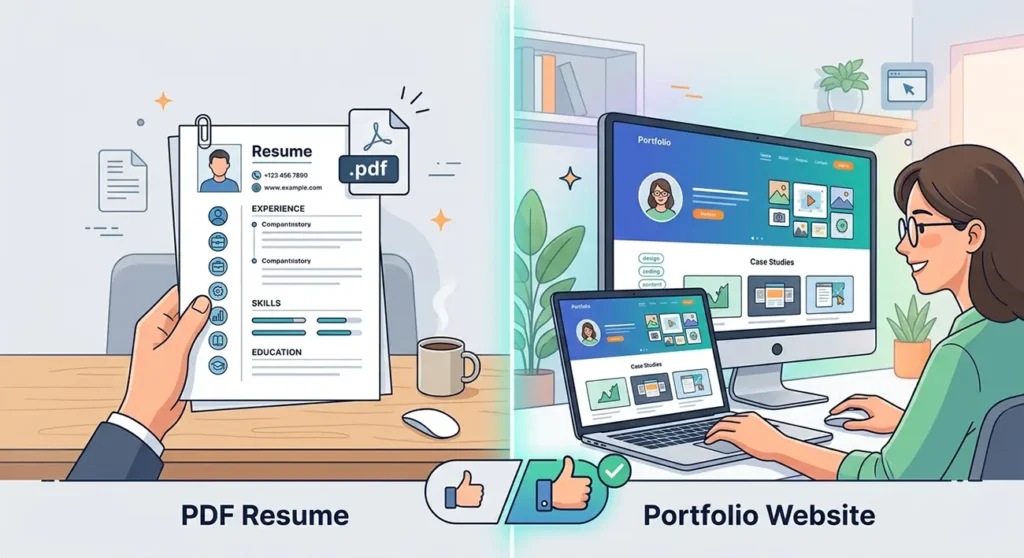
Key Takeaways
- Both formats still matter: a PDF resume gets a candidate through the door, while a portfolio website proves the claims made on that resume.
- ATS systems still read PDFs first. Most corporate applications are filtered through software before a human ever sees a portfolio link.
- Portfolio websites win for visual and project-based roles such as design, writing, development, marketing, and freelance work.
- The safest strategy in 2026 is a hybrid one: a lean PDF resume with a portfolio link, not a choice between the two.
- Recruiters spend seconds, not minutes, on both formats during the first pass, so clarity beats creativity.
Job seekers, freelancers, and career changers ask a version of the same question every week: should the resume be a PDF, or is it time to send a portfolio website link instead? The honest answer, based on how hiring managers and clients actually behave, is that this is rarely an either-or decision. Employers form a first impression from one format and confirm it with the other, and understanding that order changes how both should be built.
When a PDF Resume Still Wins the Interview
Corporate hiring pipelines are built around applicant tracking systems, and those systems are still far more comfortable parsing a PDF than crawling a website. A recruiter at a mid-size company scanning 200 applications for one role is not clicking through ten portfolio sites before the shortlist is even created. The PDF is what gets an application past the first filter, so skipping it in favor of ‘just visit my site’ is a common and costly mistake.
A PDF resume also travels well. It can be attached to an email, uploaded to a job board, forwarded internally between a recruiter and a hiring manager, and printed for an interview panel without losing formatting. A portfolio website depends on an internet connection, a working domain, and the recipient actually taking the extra step to click through. For roles in finance, healthcare administration, operations, and most traditional corporate positions, the PDF resume is still the primary document that gets read first.
When a Portfolio Website Gives You the Edge

The picture flips for roles where the work itself is the proof. A freelance graphic designer chasing a new client, a front-end developer applying to a startup, or a writer pitching a content agency is not just listing responsibilities, they are demonstrating capability. A resume can say ‘designed marketing materials for five clients.’ A portfolio website can show those five projects, the thinking behind them, and the results they produced.
This is also where career changers benefit the most. Someone moving from teaching into UX design, for example, has a resume that looks unrelated to the new field on paper. A portfolio website lets that person build a narrative: case studies, personal projects, and a clear explanation of transferable skills that a two-page PDF simply cannot hold without becoming cluttered.
Method 1: Use the Portfolio to Prove the Resume, Not Repeat It
The strongest portfolios do not restate the resume in website form. They expand on it. If the resume says a project increased engagement by 30 percent, the portfolio is where that claim gets a case study, a screenshot, and a short explanation of the approach taken. Most job seekers find that recruiters trust numbers more when there is a visible project behind them.
Method 2: Let the Job Type Decide the Format Priority
For a corporate or government role, lead with the PDF and treat the portfolio as a supporting link. For a creative, technical, or freelance role, lead with the portfolio and keep the PDF as a clean, downloadable backup. This works best when the format matches how the hiring side actually reviews candidates, rather than following a single rule for every application.
Building a Portfolio Website Employers Will Actually Use
A portfolio website only helps if someone actually opens it, understands it, and remembers it. That means the homepage needs to answer three questions within the first ten seconds: who this person is, what they do, and what proof exists that they are good at it. Tools like a portfolio builder designed specifically for job seekers and freelancers can shortcut a lot of this setup work, since the layout decisions are already handled.
- Step 1: Lead with a short headline stating the role or specialty, not a generic ‘welcome to my site’ message.
- Step 2: Feature three to five of the strongest projects, not every project ever completed.
- Step 3: Add a one-paragraph case study per project, covering the problem, the approach, and the outcome.
- Step 4: Include a visible, working contact method above the fold, not buried in a footer.
- Step 5: Link the PDF resume directly from the site so both formats are always one click apart.
Pro-Tip: Most portfolio sites lose the reader by opening with a long personal bio. Recruiters and clients skip that section almost every time. Move personal background below the project section, not above it.
How Recruiters and Hiring Managers Actually Behave With Each Format
A recruiter reviewing a stack of applications spends very little time per resume during the first pass, often less than 30 seconds. That short window means a PDF needs to be scannable, not dense. When a portfolio link is included, it usually only gets opened after the resume has already earned interest, meaning the portfolio’s job is to confirm a good first impression, not create one from nothing.
Freelance clients behave a little differently. Someone hiring a freelancer off a proposal or referral often opens the portfolio before ever reading a formal resume, since the work samples are what determine trust. This is why freelancers who rely only on a PDF resume, with no visible project samples anywhere, tend to lose bids to freelancers who can be evaluated visually within seconds.
The Hybrid Approach Most Professionals Overlook
The most effective setup treats the PDF resume and the portfolio website as two parts of one system instead of competing formats. The resume gets someone through automated filters and busy first scans. The portfolio then does the slower, deeper work of building confidence once someone is already interested. Skipping either one removes a step that most hiring processes are already expecting.
A simple version of this: the PDF resume includes one clean, clickable link to the portfolio near the contact details at the top, not buried at the bottom. The portfolio, in turn, offers a downloadable version of the same PDF so a recruiter can save it to a file without having to ask for it separately. Comparing setup options on a page like a plan comparison built for individual professionals can help decide how much structure is actually needed before building this out.
Common Mistakes to Avoid
- Sending only a portfolio link with no attached resume for corporate roles that rely on ATS screening.
- Building a portfolio with no clear focus, mixing unrelated projects that dilute the specialty being applied for.
- Letting the PDF resume and the portfolio contradict each other on job titles, dates, or project details.
- Hiding the portfolio link in small text at the very bottom of the resume where it is easy to miss.
- Treating the portfolio as a finished product and never updating it after landing the first few projects or jobs.
Tips for the Future
Both formats need regular maintenance, not a one-time setup. A PDF resume should be revisited before every new application cycle, not reused unchanged for years. A portfolio website should be updated every time a strong new project is completed, and older, weaker work should be retired to keep the overall standard high. The key is to treat both as living documents tied to current goals, not static files created once and forgotten.
As hiring continues to lean more heavily on visible proof of skill, especially in freelance and digital-first industries, the professionals who keep both formats current tend to have a noticeably easier time getting responses. Checking analytics on the portfolio site periodically also helps confirm whether visitors are actually reaching the contact section or dropping off earlier in the page.
Frequently Asked Questions
Do employers still ask for a PDF resume, or is a portfolio website enough now?
Most employers still expect a PDF resume, especially for roles processed through an applicant tracking system. A portfolio website is usually treated as a supporting link rather than a replacement.
Which format do applicant tracking systems prefer?
Applicant tracking systems are built to parse PDF and Word documents, not full websites. A portfolio link included in the resume is not scanned the same way, so the PDF should always contain the core information needed to pass automated screening.
Should freelancers rely only on a portfolio website?
Not entirely. A portfolio website is important for showing work samples, but a short, professional resume or one-page summary still helps when a client wants a quick overview of experience and rates before browsing full projects.
Is it fine to include a portfolio website link inside a PDF resume?
Yes, and it is recommended. Placing the link near the contact information at the top of the resume makes it easy to find without depending on the reader to search for it.
What should a portfolio website include that a resume cannot show?
A portfolio can include visual work samples, case studies explaining the process behind a project, client or employer results, and interactive examples, none of which fit well into a one or two page resume format.
Do career changers benefit more from a portfolio website than a resume?
Career changers often benefit significantly from a portfolio website, since it allows them to present relevant projects and transferable skills in context, something a chronological resume struggles to show clearly.
Is a portfolio website worth building for a student or someone just starting out?
Yes, particularly for internships or entry-level roles in creative, technical, or content-related fields. Even a small number of class projects or personal work presented clearly can stand out more than a resume with limited formal experience.
How often should a portfolio website be updated?
A portfolio should be reviewed every few months and updated whenever a stronger project replaces an older, weaker one. An outdated portfolio with old or irrelevant work can hurt credibility more than having no portfolio at all.